Free AI Image Generators in 2026: How to Compare Them Honestly
A dated, source-linked comparison of free AI image options, with a checklist for limits, privacy, editing, output rights, and the workflow each product suits.
Information checked July 17, 2026. Free plans change often. Treat this as a decision guide, then check the linked product page before beginning a large or commercial project.
Most comparisons rank image generators by a vague idea of "quality." That is not how people choose tools in practice. Account requirements, current limits, editing controls, privacy, and licensing can matter more than a beautiful demo image.
Start with the job
Write down the output you need before opening five tabs. Is it a one-off blog illustration, readable text inside a poster, a private client concept, or a character you will reuse? The same tool will not be best at all four.
A current snapshot
- ImageFree.net: no credit counter or account requirement; quick prompt-to-image work in five aspect ratios, but no saved history.
- ChatGPT Images: image creation is available on the free tier with stricter rate limits; conversational generation and editing require an account.
- Midjourney: no current free trial on the website or Discord; it is a paid, public-by-default community workflow with extensive art-direction controls.
- Leonardo.Ai: its help center currently lists 150 daily tokens for free users; model and settings change the token cost.
- Adobe Firefly: an account-based Adobe workflow managed through generative credits, with consumption varying by feature.
The table deliberately avoids invented "images per day" conversions. A token or credit does not always equal one image, and providers change costs by model, size, or feature.
What ImageFree.net is good at
ImageFree.net removes setup friction. Open the text-to-image generator, choose an aspect ratio, enter a prompt, and download the result. It suits quick blog visuals, concept sketches, social graphics, and experiments where account history is unnecessary.
The trade-offs are equally important: there is no prompt history, seed control, reference-image input, or character-lock feature in the current interface. Download anything worth keeping before leaving the page.
What the alternatives change
ChatGPT Images: conversation and editing
OpenAI says image creation is available on the free tier, with separate and stricter limits than paid tiers. Its current Images product can generate and edit images through conversation. That makes it useful when the task needs several rounds of directed changes rather than a single prompt. See the official free-tier FAQ and Images guide.
Midjourney: paid, not a free-tier comparison
Midjourney's own documentation says there is currently no free trial on its website or Discord. A limited trial exists only in the niji mobile app. It should not be listed as "about 25 free images"—that claim is outdated. Its terms also contain business-revenue and public-content details worth reading before client work. See Midjourney's free-trial page and commercial-use guide.
Leonardo.Ai: settings in exchange for complexity
Leonardo's help center currently states that free users receive 150 daily tokens, while generation cost depends on the model and settings. It is a better fit when you want to explore different models and controls and do not mind an account-based workflow. See its token FAQ.
Adobe Firefly: an Adobe-centered workflow
Firefly uses generative credits, with consumption depending on the feature. Adobe states that outputs from non-beta Firefly features may be used commercially, while partner models and enterprise indemnification have separate conditions. Start with Adobe's generative credits FAQ, not a third-party summary.
A five-minute comparison test
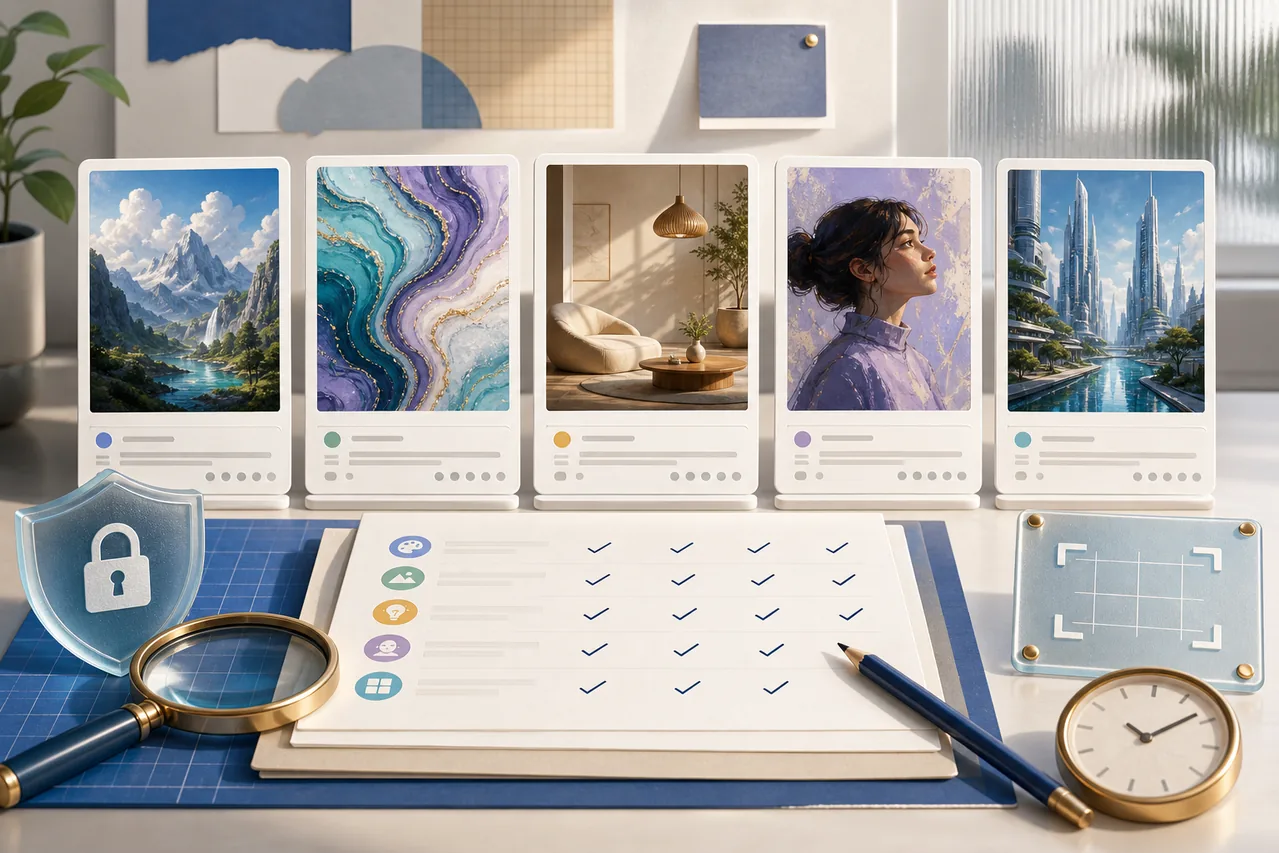
Use the same modest prompt in two or three tools. Pick a prompt with one subject, a clear setting, and no living artist reference. Then compare:
- Did it follow the composition?
- Are hands, text, reflections, and repeated objects believable?
- Can you correct a local problem without rebuilding the image?
- What happens to your prompt and uploaded files?
- Do the current terms fit your intended use?
Keep the original outputs, prompts, date, and settings. That small record is more useful than a universal ranking because it reflects your actual work.
The honest recommendation
Use ImageFree.net when speed and no-sign-up access matter. Use a conversational editor when revision matters. Use a control-heavy product when consistency, references, or private client work justify the setup. For commercial work, read the current terms yourself and avoid assuming that "free to generate" means every downstream use is risk-free.